How to Choose a Reception Desk: Sizes, Shapes, Materials and ADA Requirements

Walk into a law firm, a medical office, and a call center on the same day and you’re looking at three completely different furniture problems. The law firm needs to project credibility and house an enormous volume of physical files. The medical office needs surfaces that can be wiped down between patients and chairs that don’t create infection-control nightmares. The call center needs to keep 40 agents comfortable and focused for eight-hour shifts without spending $3,000 per seat.
Generic office furniture advice doesn’t account for any of this. “Get ergonomic chairs and a good conference table” is fine if you’re furnishing a generic startup, but it’s the wrong starting point if your industry has specific operational, compliance, or client-facing requirements that most furniture guides ignore.
At BKM Office Furniture, we work with businesses across Southern California in a wide range of industries. After nearly three decades of doing this, the pattern is clear: the companies that get their furniture right think about it through the lens of how their business actually operates, not just how they want the space to look. This guide covers the industries we work with most, and what each one actually needs.
Law firms carry more reputational weight per square foot than almost any other professional environment. A client walking into a conference room for a deposition or an initial consultation is making judgments about whether this firm is competent and trustworthy before anyone says a word. The furniture is doing active communication work.
At the same time, legal offices are among the heaviest users of physical storage in any professional category. Despite the ongoing push toward digital files, active case files, signed originals, and privileged documents require physical, lockable, often fireproof storage at a volume most other industries have moved away from.
Conference tables and seating. The conference room is where the work happens in a law firm, whether that’s depositions, client meetings, partner reviews, or mediations. The table needs to seat enough people comfortably, project a level of quality that matches the firm’s positioning, and hold up under heavy daily use. A high-pressure laminate or wood veneer table in a classic shape reads as competent and established. A cheap folding table does not. See our conference table buying guide if you’re sizing and specifying a room.
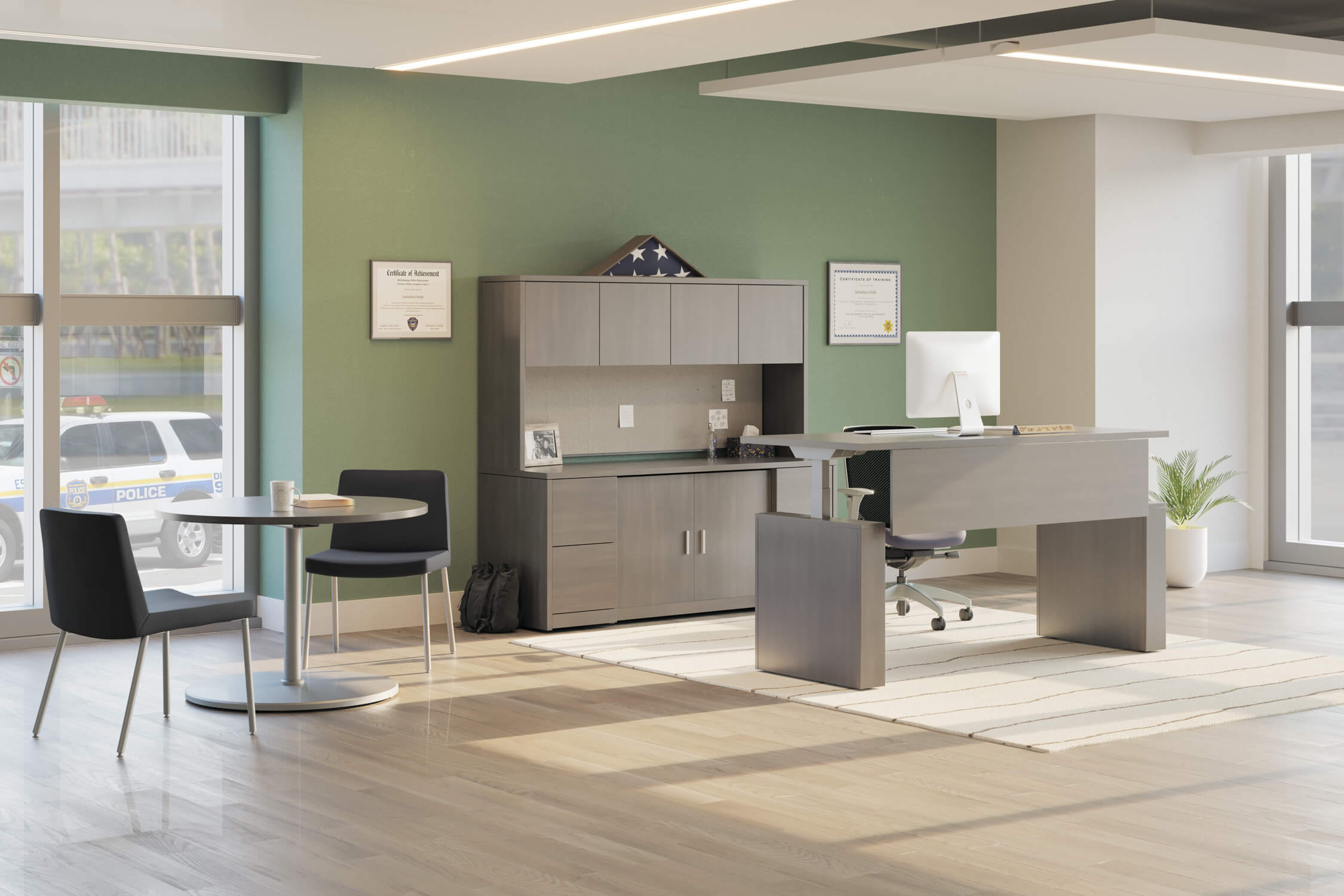
Attorney workstations and executive desks. Partners and senior associates typically need a substantial desk configuration, either an L-shaped or U-shaped setup, that gives room for active case materials, a computer setup, and the ability to review physical documents without clearing the desktop each time. An executive credenza behind the desk handles overflow storage and keeps the client-facing surface clean.
Filing and storage. This is where law firms consistently under-invest and then overspend later to fix. Lateral files with fire ratings for original documents, lockable cabinets for active client files, and a clear plan for archiving closed cases are all part of getting this right the first time. Our Office Storage Solutions Guide covers what to look for in legal filing scenarios specifically.
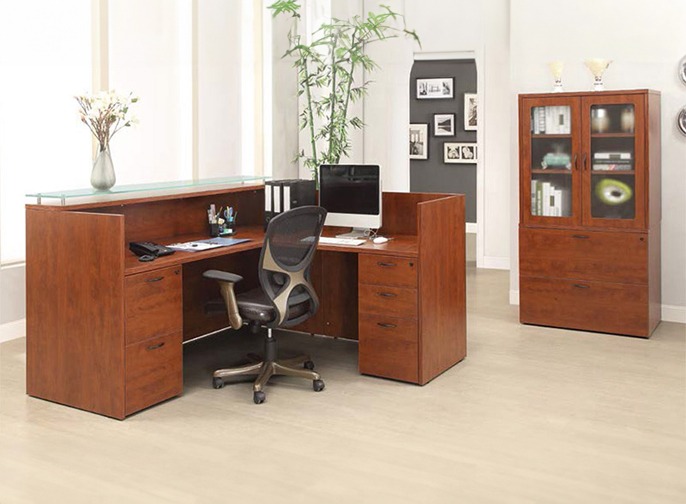
Reception and waiting area. The reception desk sets the first impression. It should feel substantial, be staffed comfortably, and include secure storage for intake paperwork and firm materials. Waiting room seating needs to handle extended waits without looking institutional. Quality lounge seating in neutral, durable materials strikes the right tone.
Cheap laminate that chips or peels within two years. In a law firm, deteriorating furniture reads as a firm in decline. It’s worth spending more upfront or buying quality used commercial furniture than buying budget-tier new pieces that won’t last.
Infection control is the factor that separates medical office furniture from every other category. Surfaces that can’t be wiped down with clinical-grade disinfectants, seams where fluid or pathogens can accumulate, and upholstery that absorbs rather than repels are not just inconvenient in a healthcare setting: they’re potential compliance and liability problems.
The second factor is patient experience. Medical offices, particularly specialist practices, primary care offices, and therapy practices, need waiting areas that reduce anxiety rather than amplify it. Hard, institutional seating in a cold waiting room is a missed opportunity that affects patient perception of care quality before the appointment even begins.
Clinical seating with sealed upholstery. Any chair that will be used in examination areas, waiting rooms, or consultation spaces should have upholstery that can be cleaned with standard clinical disinfectants without degrading over time. Look for antimicrobial vinyl or sealed upholstery grades specifically rated for healthcare environments. Standard fabric chairs are the wrong choice for any patient-contact area.
Reception and check-in desks. A medical reception desk needs to handle a high volume of patient interactions efficiently, often with two or more staff working simultaneously. Barrier height sections for privacy, secure storage for medical records and intake forms, and enough counter depth for computers and paperwork without clutter are all practical requirements, not aesthetic ones. Our guide on reception desk height and dimensions covers the specifics of sizing these correctly.
Waiting room seating. Healthcare waiting areas benefit from seating that is comfortable enough for extended waits, easy to rearrange for social distancing or capacity management, and available in configurations that accommodate patients of different mobility levels. Bariatric-rated seating options should be considered if your patient population includes a range of body types, since standard chair weight ratings are not always sufficient.
Staff and administrative workstations. Back-office staff in medical settings often need multi-monitor setups for accessing electronic health records and scheduling systems, with enough desk depth for note-taking alongside screen work. Ergonomics matter here too, since administrative staff in medical offices frequently work long shifts with limited break opportunities.
Lockable filing and storage. HIPAA compliance requires that patient records, physical or electronic, be stored securely. Lockable lateral files and cabinets for administrative areas, combined with secure storage at clinical stations, are both practical and regulatory requirements rather than optional upgrades.
Upholstered seating with welt cord or button tufting in patient areas. These design features create seams and grooves where contamination can accumulate and where cleaning is genuinely difficult. They belong in executive offices, not clinical environments.
Call centers have an unusual furniture problem: they need to maximize the number of workstations per square foot while maintaining enough acoustic separation that agents aren’t constantly disrupting each other, and they need to do it with seating that holds up under full-shift daily use from multiple users per station. Budget chairs that feel fine for two hours become a physical and productivity problem after six.
The ratio of chairs to seats often exceeds one-to-one in call centers, since shift overlap means more people than desks at transition times. Durability, replaceability, and ergonomic performance under extended use are the relevant metrics, not aesthetics.
High-durability task chairs. This is the most important purchase decision in a call center environment. Agents sitting for six to eight hours per shift in chairs that offer poor lumbar support or inadequate height adjustment range will experience fatigue that directly affects call quality, patience with customers, and error rates. The cost of a better chair is recovered quickly in reduced absenteeism and turnover. Look for chairs with full height adjustment range, adjustable lumbar, and breathable mesh backs that manage heat over long sessions. Our types of office chairs guide breaks down the categories that apply to high-use environments.
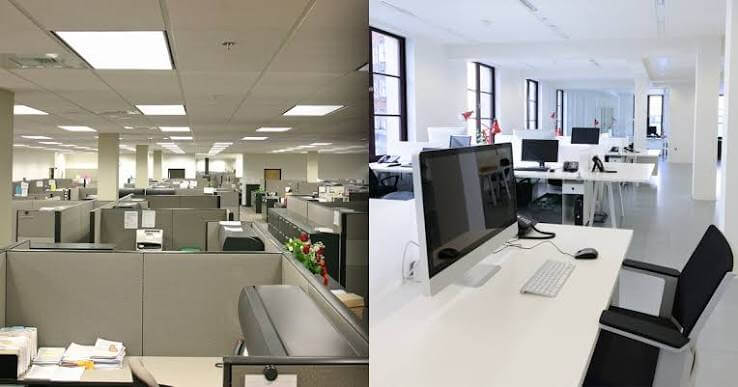
Panel-based or systems workstations. Open benching gives maximum density but zero acoustic separation. Panel systems at 48 to 53 inches give agents enough visual and acoustic separation to focus without making the floor feel like a maze. Getting the panel height right is a planning decision worth investing time in before purchasing. Our office cubicle design post covers panel configurations in detail.
Acoustic considerations. Panels alone don’t solve call center noise. Surface-mounted acoustic panels, sound-absorbing ceiling tiles, and proper workstation orientation all contribute. Furniture dealers who understand call center environments will raise these questions during the planning phase rather than just delivering chairs and panels.
Supervisor and team lead stations. Most call center floors include elevated or centrally positioned supervisor stations that need better sightlines, multi-monitor capacity, and slightly higher-quality seating than standard agent stations. Planning these into the layout from the start avoids retrofitting.
Cheap task chairs bought in bulk on price alone. In a call center, the chair is the most frequently used and most quickly worn piece of furniture in the building. Buying the lowest-cost option and replacing it every 18 months costs more over five years than buying commercial-grade chairs in the first place.
Real estate brokerages and financial services offices share a common requirement: the furniture needs to simultaneously convey success and accessibility. Clients walking into a real estate office or a financial advisor’s space are making large, emotionally loaded decisions. The environment either reinforces their confidence in the people they’re working with or quietly undermines it.
These offices tend to have a mix of private offices for senior agents or advisors, open workstation areas for support staff and junior associates, and at least one well-appointed meeting space for client consultations.
Private offices with executive credibility. Senior agents and financial advisors need desk configurations that project competence without being ostentatious. A quality executive desk, a comfortable guest seating arrangement for two or three clients, and enough surface area to spread out contracts or financial documents without crowding are the practical requirements.
Clean, professional open workstations. Support staff and junior associates need workstations that are efficient and organized without looking chaotic. Panel systems or open benching with good cable management and sufficient storage keep the floor looking professional rather than like a bullpen.
A client-ready meeting room. Even a small conference or meeting room gives agents and advisors a private, professional space for consultations that isn’t the corner of an open floor plan. A simple round or rectangular table with four to six chairs and adequate lighting covers most needs at this scale.
Mismatched furniture across the floor. In environments where client impressions matter, inconsistent furniture (different chairs at different stations, mismatched storage) reads as disorganization. A cohesive floor plan, even with modest furniture, looks more professional than expensive pieces that don’t relate to each other.
Design-oriented businesses use their office as a demonstration of their own capability. An architecture firm or interior design studio that has a poorly planned, aesthetically inconsistent workspace is sending a message about their work before any portfolio is opened.
Beyond aesthetics, creative studios have functional requirements around large-format work: reviewing blueprints and renderings, spreading out material samples, collaborating around drawings, and working between digital and physical media throughout the day.
Large work surfaces. Design work requires more desk depth and surface area than standard computer work. Drafting tables for firms doing physical drawing work, wide desks with generous depth for digital design work, and large central tables for collaborative review sessions are all common requirements. If staff are moving between standing and seated positions throughout the day as they review physical work, height-adjustable surfaces add real workflow value. See our breakdown of types of desks for the configurations that work best in design environments.
Adjustable and drafting chairs. Traditional seated work alternates with standing review in most design studios. If your team regularly stands at tables to review drawings or mark up prints, having the right chair for alternating between seated desk work and elevated standing-height review matters. Our drafting chair guide covers what separates a proper drafting chair from a standard task chair.
Flexible collaborative areas. Design work is inherently collaborative. A central table that a team can gather around to review work, with enough surface for multiple documents to be open at once, is often more valuable than a formal conference room. Lightweight, stackable chairs in a collaborative area allow the space to flex between a team meeting and a solo focus area without requiring a full furniture reconfiguration.
Storage for materials and samples. Design studios accumulate material samples, product catalogs, and physical reference files at a volume that most other offices don’t. Open shelving, lateral storage, and organized sample libraries keep these accessible without making the studio look like a stockroom. Our office shelving ideas post covers how to integrate this kind of storage without sacrificing the aesthetic.
Purely aesthetic furniture choices that can’t support real work. A beautiful minimal desk that’s 20 inches deep doesn’t work for spreading out architectural drawings. Function has to lead, with aesthetics layered on top.
Government offices and educational institutions have budget structures that differ meaningfully from private sector organizations. Furniture often goes through a procurement process with specific approval requirements, and total cost of ownership over a long lifecycle matters more than it does in sectors where furniture gets upgraded every five to seven years.
Durability, warranty coverage, and the ability to source matching pieces years later for expansion are all relevant considerations that private sector buyers rarely think about.
Commercial-grade durability over budget-tier pricing. Government offices that buy cheap furniture to hit a budget number often find themselves in a replacement cycle that costs more over ten years than buying commercial-grade pieces once. Steelcase, Haworth, and similar commercial-grade brands are built to hold up under daily institutional use for 15 or more years.
Standard, reorderable configurations. A modular panel system or a desk line from a major manufacturer that will still be in production in five years gives institutions the ability to add workstations for new hires without a full refurnish. Buying discontinued or clearance-only furniture saves money once and creates a headache every time the space grows.
Ergonomics for extended use. Teachers, administrators, and government staff who sit for long hours have the same physical requirements as any other full-time desk worker. Dismissing ergonomic seating as a budget luxury in public sector contexts leads to the same productivity and absenteeism costs it does anywhere else. Our post on ergonomic issues in the workplace covers the real costs of inadequate seating in measurable terms.
Government agencies and educational institutions are also among the best candidates for quality used commercial furniture, for a specific reason: used commercial-grade furniture from a reputable dealer is often more durable than new budget-tier furniture bought new through a low-bid procurement process. A used Steelcase workstation system bought from BKM can easily outlast a new no-name panel system bought for the same price. Our new vs. used office furniture guide covers how to evaluate this tradeoff honestly.
Regardless of industry, the planning sequence that consistently produces the best results is the same.
Start with how your team actually works, not how you want the space to look. The most common furniture mistake across all industries is prioritizing aesthetics before function and then retrofitting practical solutions into a space that wasn’t designed for them.
List the compliance and durability requirements specific to your environment before you start shopping. Healthcare infection control, legal fireproofing, and call center shift durability are all requirements that narrow the field before aesthetics enter the conversation at all.
Work out your space plan before you buy anything. Knowing how many workstations, how much storage, and what size conference or collaboration space you need prevents both over-buying and the more expensive problem of under-buying and adding piecemeal later. Our office space planning guide walks through this process.
Decide where new versus used makes sense by category rather than buying entirely one way or the other. In most industries, some categories (seating, filing, systems workstations) are excellent used buys, while others (reception desks where aesthetics are a priority, height-adjustable mechanisms) often warrant buying new.
Whether you’re furnishing a law office in downtown Los Angeles, a medical practice in Orange County, or a call center in the San Fernando Valley, our team at BKM has worked with businesses in your industry before and can help you avoid the mistakes we’ve seen others make. Visit one of our Southern California locations or reach out to our team through our office furniture consulting service to get started.