How to Choose a Reception Desk: Sizes, Shapes, Materials and ADA Requirements

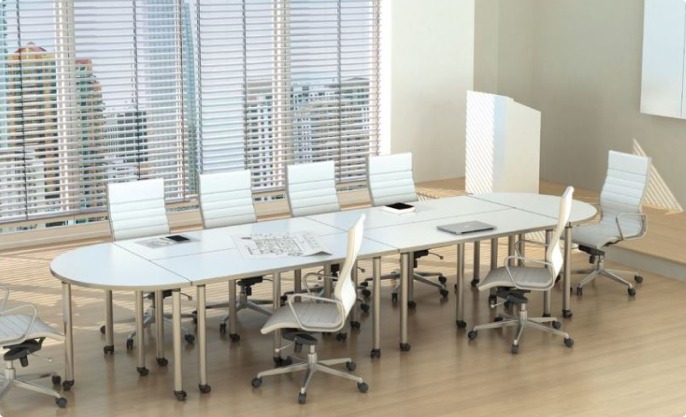
Walk into almost any office and the conference table tells you something before anyone says a word. Is it scratched and wobbly, or solid and well-kept? Does it fit eight people comfortably, or are elbows bumping by the third chair? A conference table isn’t just a flat surface to set laptops on. It’s where decisions get made, deals get closed, and first impressions get formed. Buying one deserves more thought than picking the first rectangle that fits the room.
Here are seven things worth slowing down for before you commit.
It’s tempting to fall in love with a table online and then try to make it work. Flip that order. Start with the room.
A table can technically fit in a room and still make that room unusable. Leave at least 36 inches of clearance between the edge of the table and the wall (more if there are credenzas, whiteboards, or doors swinging into the space) so people can push back chairs and walk around without an awkward shuffle.
Also Read: Conference Room Sizes: Office Space Planning Guide
It’s easy to count the chairs you need right now and stop there. But conference tables aren’t bought every year, so it pays to think a step ahead.
A comfortable seat needs roughly 24 to 30 inches of table edge. Cramming more chairs in than that ratio allows looks fine in a product photo and feels terrible in a real meeting.
If your team is growing or your headcount fluctuates with projects, modular conference tables, built from sections that can be reconfigured or extended, offer flexibility that a single fixed slab can’t. It’s a practical way to avoid buying twice.
A conference table takes more daily abuse than almost any other piece of office furniture: laptops sliding across it, coffee rings, the occasional dropped binder.
The edges of a table take the most physical contact and wear. Thicker, well-sealed edge banding resists chipping and peeling far longer than thin, cheaply applied trim, even if the tabletop surface looks identical at first glance.
Few meetings today happen without a laptop, a phone charging, or a video call running. A table that ignores that reality will frustrate people daily.
Grommets with power outlets and USB ports recessed into the tabletop keep cords off the floor and within easy reach, instead of forcing people to crawl under the table or run extension cords across the walkway.
Good cable management isn’t just about the tabletop. It’s also about where those cables go afterward. Tables with routed channels or covered raceways in the base keep cords organized and out of sight, which matters as much for safety as it does for appearance.
The conference table often sits in the most visible room in the office, the one clients and candidates see. It should feel like it belongs.
A sleek glass-and-chrome table looks out of place next to traditional wood desks down the hall, and vice versa. Consistency across your office furniture creates a more polished, intentional look rather than a mismatched one.
Modern minimalist lines suggest an innovative, fast-moving company. Traditional wood finishes suggest stability and established credibility. Transitional designs blend both. None of these is “right.” The right one is the one that matches how you want clients and employees to perceive your business.
Price is always part of the conversation, but it’s worth widening the lens beyond just “new.”
A well-maintained used conference table can offer the same durability and presence as a new one at a fraction of the cost, particularly for solid wood or higher-end designs where the savings are most significant. Many businesses are surprised at the quality available in the used market once they actually look.
A cheaper table that needs replacing in three years isn’t actually cheaper. Factor in expected lifespan, warranty coverage, and how easily the table can be repaired or refinished down the road, not just the price tag today.
A table that looks great in a showroom can still make meetings physically uncomfortable if the practical details are off.
Standard conference table height is around 29 to 30 inches, but it only works well when paired with chairs at the right height to match. If you’re sourcing the table and chairs separately, double-check that the combination actually works together before committing to either.
Bulky aprons or low cross-bars underneath the table can eat into legroom in ways that aren’t obvious from a product photo. Rounded or beveled edges are also easier on forearms during meetings that run long, a small comfort detail people notice without realizing why.
A conference table is a long-term investment in how your business meets, presents itself, and functions day to day. Taking the time to think through size, capacity, materials, technology, style, budget, and comfort up front saves you from a costly do-over later.
If you’re ready to start exploring options, new or gently used, in a range of sizes, shapes, and finishes, take a look at BKM Office Furniture’s selection of conference tables. Our team can help you find a table that fits your room, your budget, and the way your team actually works.