How to Choose a Reception Desk: Sizes, Shapes, Materials and ADA Requirements

Storage is the last thing anyone budgets for and the first thing they regret skipping. We see it constantly at BKM Office Furniture: a company spends weeks picking out the right chairs, the right desks, the right conference table, and then storage gets handled in the final ten minutes with a “throw in a few file cabinets” comment. Six months later, that same office is calling us back because the file room is overflowing, the lockers have no ventilation, or the credenza in the executive office is the wrong height for the printer that’s supposed to sit on it.
This guide is the one we wish more people read first. It covers the three pieces of furniture that quietly run every office, how to figure out how much you actually need, when buying used makes sense, and the mistakes that lead to that six-month-later phone call.
Storage doesn’t photograph well. It doesn’t show up in a mood board the way a sleek conference table does, so it gets treated as an afterthought rather than a planning decision. The problem is that storage needs are driven by things that don’t change just because you didn’t plan for them: how many active client files your team keeps, how many employees need a secure place for personal items, how much you need to display versus hide in a reception or executive space.
When storage is an afterthought, you end up buying twice. Either you under-buy and add piecemeal cabinets every few months (which never match and eat up floor space inefficiently), or you over-buy generic units that don’t fit how your team works. Treating storage as its own category, with its own measurements and its own decisions, is what actually saves money.
Filing cabinets exist to hold paper records in a way that keeps them organized, accessible, and protected. They come in two main formats, vertical and lateral, which we break down in detail below. This is the category with the most variation and the most room for buying the wrong thing.
Lockers give individual employees a secure, personal space that isn’t tied to a fixed desk. They used to be a warehouse and gym-only fixture. With hybrid schedules and hot-desking now standard in a lot of offices, lockers have quietly become one of the most requested items we get calls about, because a desk that changes hands every day still needs somewhere for a coat, a laptop bag, or personal items to live securely.
A credenza is a low storage cabinet, usually placed behind or beside a desk, that does double duty as storage and as a secondary work or display surface. They’re most common in executive offices, conference rooms, and reception areas, where they hold everything from supplies and equipment to printers and presentation materials, without looking like a filing cabinet bolted to the wall.
This is the single most common question we get on the showroom floor, and most online guides answer it with a generic “it depends.” Here’s the actual breakdown.
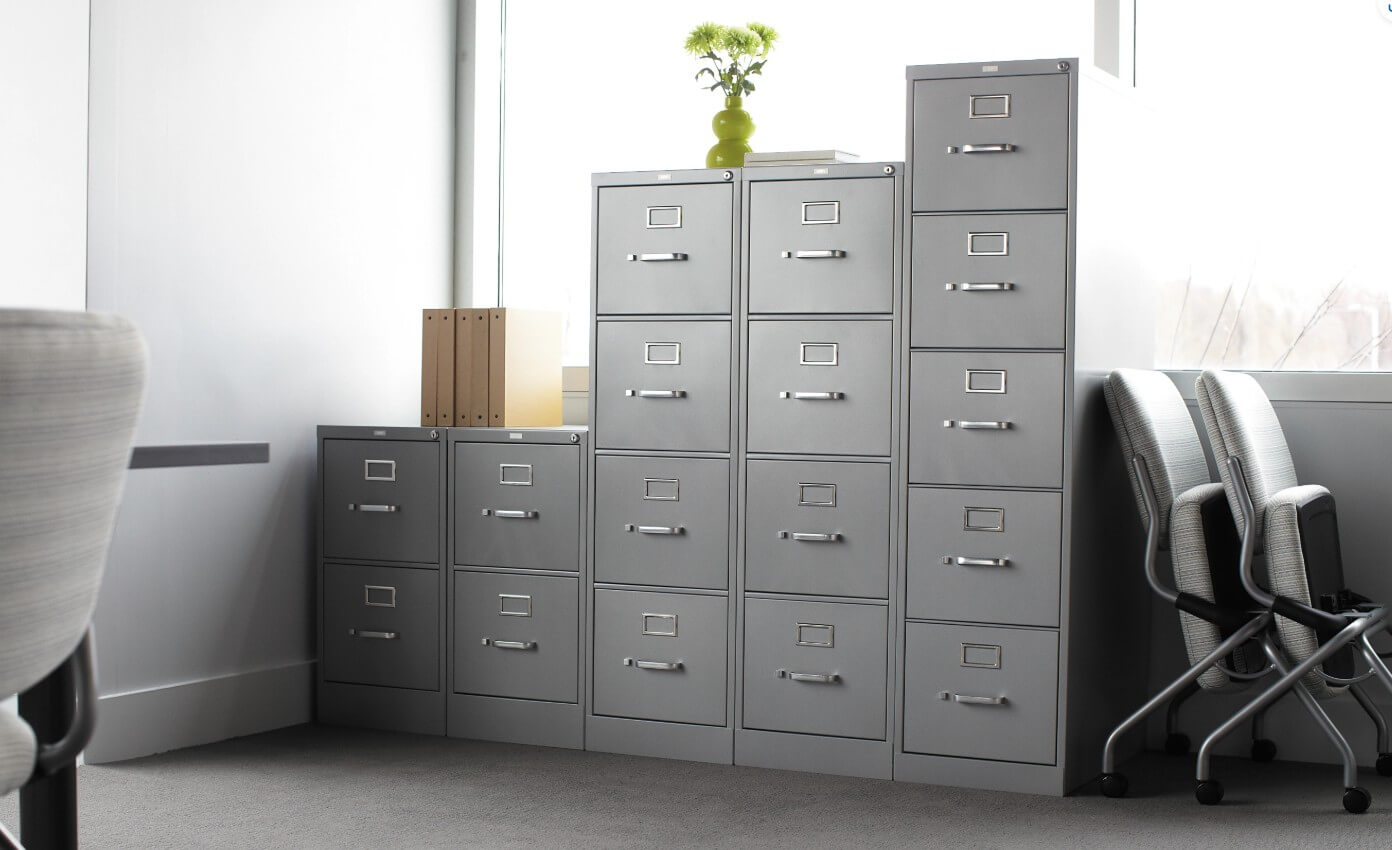
Vertical filing cabinets are taller and narrower, with drawers that pull straight out toward you. They’re the right choice when floor space is tight and you need depth rather than width, like a small office, a narrow hallway nook, or a cubicle that needs a cabinet tucked beside the desk.
Lateral filing cabinets are wider and shallower, with drawers that open side to side. They hold more files per drawer, are easier for multiple people to access at once without colliding with an open drawer, and tend to look more like furniture than equipment, which is why they show up so often in open offices and reception areas.
If your team is small and files are accessed by one or two people, vertical cabinets are usually the more space-efficient pick. If multiple people need to grab folders throughout the day, or the cabinet will live in a visible part of the office, lateral files almost always win.
Most people buy filing cabinets by eyeballing the room rather than measuring their actual file volume, and it’s the number one reason offices end up either cramped or with empty drawers six months later. Here’s a quick way to get it right.
A standard banker’s box holds roughly one linear foot of hanging files. A typical 36-inch wide lateral file drawer holds about 30 to 33 inches of hanging file space, which is close to three banker’s boxes worth of files per drawer. A standard vertical legal or letter-size drawer holds slightly less, closer to two banker’s boxes.
So if your HR department currently has 12 boxes of active files, you’re looking at roughly four lateral drawers, or about one to two standard lateral cabinets depending on height. Count your actual boxes (or estimate from your current file room) before you shop, and you’ll avoid both the overflow problem and the wasted-drawer problem.
Not every file needs fire protection or a lock, and paying for it across the board is a waste of budget. But some records genuinely require it, and skipping it isn’t just inconvenient, it can be a compliance problem.
You should be looking at a fireproof, rated cabinet (commonly UL Class 350 for paper records) for original signed contracts, leases, or corporate documents that can’t be reproduced; HR personnel files containing Social Security numbers or medical information; medical or patient records subject to HIPAA; and financial records required for audits or tax purposes.
A standard locking cabinet, without a fire rating, is usually enough for day-to-day client files, project records, or anything sensitive but replaceable. The mistake we see most often is companies buying fire-rated cabinets for everything, which roughly doubles the cost per drawer for protection that most of the files inside don’t need.
The biggest shift we’ve watched in the last few years is how often lockers come up in office furniture conversations that have nothing to do with industrial or retail settings. Hybrid schedules mean a lot of desks are shared across two, three, or more people throughout the week, and a shared desk creates a real problem: where does someone keep a laptop, a charger, or personal items securely when they’re not the one sitting there that day?
Day-use lockers, smaller than a gym locker and usually without a full-height design, solve this without requiring every employee to have an assigned desk. They’re also showing up in coworking spaces, law firms with rotating associates, and any office that’s downsized its real estate but kept the same headcount. If your office has moved toward hot-desking in the last couple of years and storage hasn’t been part of that conversation, it’s worth revisiting.
Ask most people to picture office storage and they think of a filing cabinet. Almost nobody pictures a credenza, even though it’s doing more work in more rooms than people realize.
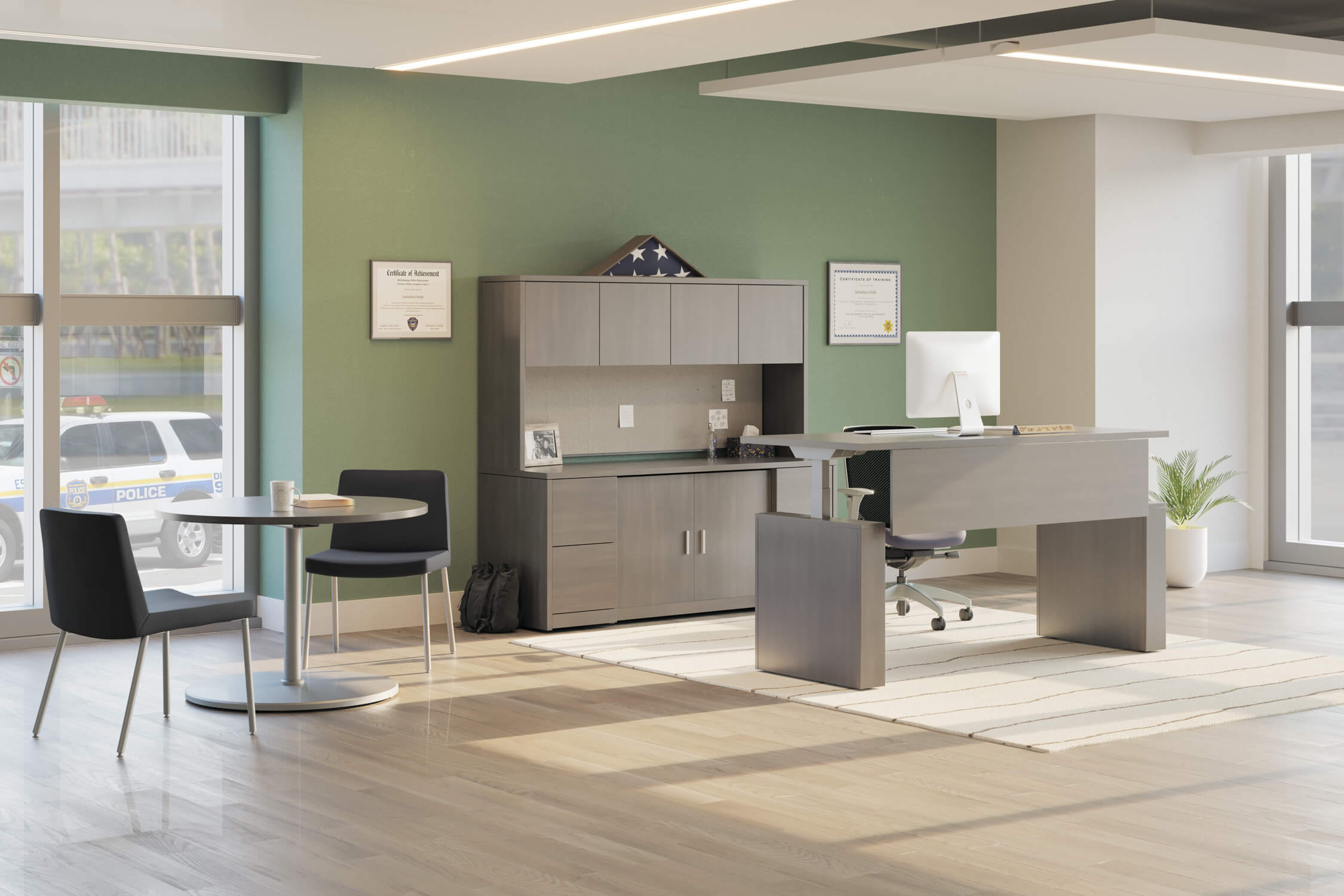
In an executive office, a credenza holds the printer, supplies, and personal items that would otherwise clutter the desk, while still looking intentional rather than purely functional. In a conference room, it’s where AV equipment, extra supplies, and presentation materials live without taking up table space. In reception, it can hold marketing materials and paperwork while doubling as a surface for a printer or coffee station.
The mistake we see most is treating the credenza as a style decision instead of a functional one. Before choosing a finish, measure what actually needs to sit on top of or inside it. A credenza that’s two inches too short for the printer that’s supposed to go on it is a daily annoyance nobody plans for.
We’ve been selling both new and used office furniture since 1997, and storage is one of the categories where we tell customers, honestly, that used is often the smarter buy. Filing cabinets and credenzas are built from steel and laminate, materials that don’t wear out the way upholstered chairs do. A well-built used lateral file from a major manufacturer can easily outlast a budget new unit, often at a fraction of the price.
What’s worth checking before you buy used: drawer glide smoothness (open and close every drawer, since sticking or grinding usually means worn glides that are a real headache to fix later); lock cylinder function (test the lock with a key if one’s included, because a missing or non-functioning lock on a unit you need secured is a deal-breaker, not a minor flaw); rust and dents on load-bearing edges (cosmetic scuffs on the side of a cabinet are fine, but rust or denting around the drawer rails or base is a sign of real wear); and interior rail condition (run a hand along the inside rails where hanging files sit, because bent or rusted rails will damage files over time even if the outside looks fine).
For a deeper look at the bigger picture of new vs. used decisions across furniture categories, we’ve covered it in detail in our New vs. Used Office Furniture guide.
Buying letter-size cabinets for legal-size documents. This sounds minor until someone’s folding contracts to fit, which damages records and looks unprofessional.
Skipping fire ratings on the one cabinet that actually needed it. Usually the HR files. Usually discovered during an audit, not before.
Lockers with no ventilation in a warm storage room. Gym bags and lunches in a sealed metal box without airflow is a smell problem waiting to happen.
Matching furniture style over function. A beautiful credenza that’s too shallow to fit a standard printer gets relegated to a closet within a year.
Forgetting clearance space. Lateral file drawers need room to fully extend. Cabinets placed too close to a wall or another piece of furniture become only half-usable.
Law firms: lateral files with fire ratings for client records, lockable cabinets for active case files, credenzas in partner offices.
Medical offices: fireproof, lockable filing for HIPAA-covered records, lateral files for high-volume daily access by multiple staff.
Coworking spaces and hybrid offices: day-use lockers as a priority, with lighter filing needs since most records are digital.
Corporate headquarters and reception areas: credenzas for presentation and display, lateral files for shared department records, vertical cabinets tucked into smaller individual offices.
You can find all the industries we serve here.
For a team of five to ten people with standard administrative records, one to two lateral filing cabinets is typically enough if records are kept current and old files are archived or digitized regularly. Use the box-count method above rather than guessing based on office size alone.
Only for records that are genuinely irreplaceable or legally sensitive, like signed originals, HR files, or financial documents required for audits. For everyday project files, a standard locking cabinet is usually sufficient.
Yes. Even offices with assigned desks use lockers for shared equipment, secure personal storage near entrances, or shared spaces like break rooms and conference areas where personal items shouldn’t be left at an open desk.
Generally, yes, more so than most other furniture categories, because steel and laminate hold up well over years of use. Check drawer function, lock mechanisms, and interior rail condition before buying, and you’re usually getting a durable piece at a significantly lower price than new.
Storage is easy to underestimate and expensive to get wrong twice. The fix isn’t complicated: count your actual file volume instead of guessing, decide which records genuinely need fire protection or locks, and think about lockers as a real solution if your office has moved toward shared desks. Whether new or used fits your budget better depends on the piece, but for filing cabinets and credenzas specifically, used furniture is one of the smartest places to save without sacrificing quality.
If you’d rather skip the guesswork, our team can walk your space and tell you exactly what you need, in person or over the phone. Browse our current selection of New & Used Office Filing Cabinets & Lateral Files, or take a look at our Office Shelving Ideas if you’re rethinking storage as part of a bigger office layout.