How to Choose a Reception Desk: Sizes, Shapes, Materials and ADA Requirements

If you only have time for the short answer: an L-shaped desk is the right choice for most home offices, open-plan workstations, and smaller private offices because it gives you a large work surface without eating up the whole room. A U-shaped desk is the better choice when you need separate zones for computer work, paperwork, and meetings at the same desk, which is why you see them most often in executive offices, admin stations, and reception areas.
That said, “most people” doesn’t mean “you.” Below is a side-by-side breakdown of how these two desk shapes actually differ, so you can match the shape to your room, your job function, and your budget instead of guessing.
An L-shaped desk is two work surfaces joined at a 90-degree angle, forming the letter L. One side is the primary desktop and the other is a shorter “return” that typically holds a monitor, printer, or secondary work area.
Standard L-shaped desks range from about 60″ x 60″ up to 71″ x 71″ for larger corner configurations, though compact versions starting around 47″ x 47″ are common in home offices. Because one leg of the L tucks into a corner, this shape uses wall space efficiently and leaves the rest of the room open for storage, seating, or walking space.
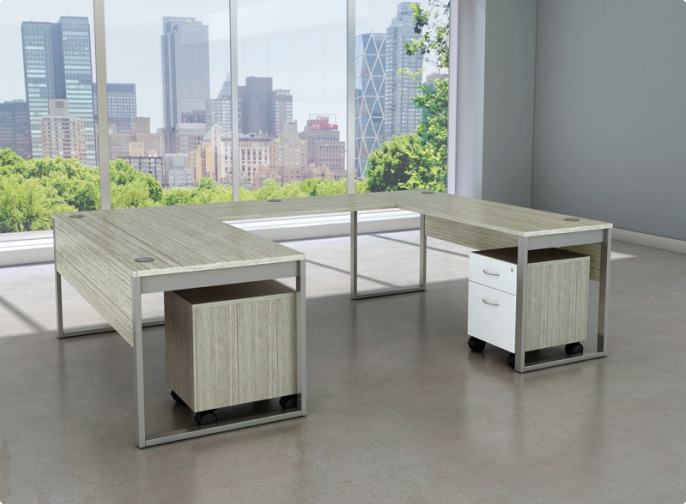
A U-shaped desk adds a third surface to the L-shaped layout, wrapping around the user on three sides. It usually consists of a main desktop, a side return, and a back credenza or bridge that connects them, forming the letter U.
U-shaped desks typically run 60″ to 96″ wide and require significantly more floor space, often a dedicated area of at least 8′ x 8′ to allow comfortable movement in and out of the enclosure. The extra surface area is the whole point: it gives one person room to run multiple monitors, spread out paperwork, and still have a clear primary desktop, all without leaving their seat.
| Work surface area | Moderate to large | Large to very large |
| Floor space needed | Smaller footprint, fits most rooms | Large footprint, needs a dedicated office |
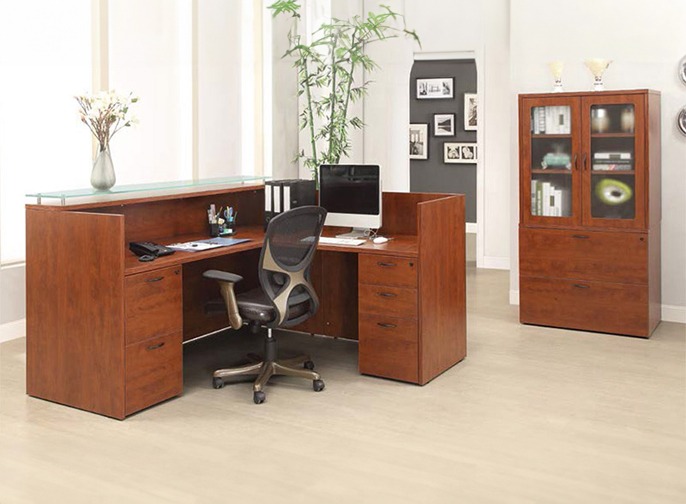
| Best for | Home offices, open workstations, smaller private offices | Executive offices, admin/reception desks, multi-monitor roles |
| Typical price range | Lower to mid-range | Mid to high-end |
| Built-in storage | Sometimes (pedestal or hutch add-ons) | Usually, via the bridge and additional returns |
| Sense of enclosure/privacy | Light, open on two sides | Strong, encloses the user on three sides |
| Best room shape | Works in square or rectangular rooms, corners | Needs a larger square footprint to avoid feeling cramped |
L-shaped desks generally cost less because they use less material, fewer connecting parts, and lighter-duty hardware on smaller models. Entry-level laminate L-shaped desks are typically the most budget-friendly option in either category.
U-shaped desks cost more across almost every price tier. You’re paying for an additional surface, more connecting hardware, and in many cases, solid wood veneers or commercial-grade laminates that hold up under heavier daily use. If a U-shaped desk also includes a hutch, locking file drawers, or a glass or wood top upgrade, expect the price to climb further. When budgeting, it helps to weigh the desk cost against what you’d otherwise spend on a separate credenza or filing cabinet to get the same storage and surface area from an L-shaped setup.
In most small or shared offices, yes. U-shaped desks need enough clearance on all sides for a chair to roll in and out comfortably, which usually means a minimum of 8 feet in each direction. If your room is smaller than that, an L-shaped desk will fit better without making the space feel closed in.
Can I add a return later to turn an L-shaped desk into a U-shaped desk?
Sometimes. Many commercial desk lines sell matching bridges and returns separately, so you can start with an L-shape and add a third surface later if your space and budget allow. Check with the manufacturer or your furniture dealer before buying, since not every L-shaped desk is designed to expand.
Which shape is better for a multi-monitor setup? A U-shaped desk gives you more continuous surface for two or three monitors plus a separate work area for a laptop or paperwork. An L-shaped desk can still handle two monitors comfortably, especially with a monitor arm freeing up desk space, but it has less room left over for anything else.
Do L-shaped or U-shaped desks work better for standing desk conversions? L-shaped desks convert more easily. Height-adjustable L-shaped models are widely available, and the smaller footprint makes the mechanism less expensive and easier to install. Height-adjustable U-shaped desks exist but are less common and significantly more expensive due to the added surface that needs to move evenly.
There’s no universal “better” shape, only a better fit for your space and your work. If you need an efficient desk that works in almost any room, an L-shaped desk is the safer, more flexible choice. If you have the square footage and your day-to-day work demands more surface, more storage, and more separation between tasks, a U-shaped desk earns its larger footprint.
If you’re still weighing your options, our office space planning guide walks through how to map out a room before you buy, and our Types of Desks and Table vs. Desk posts cover how these shapes compare to other desk styles. BKM Office Furniture carries both L-shaped and U-shaped desks across multiple price points and finishes, and our team can help you measure your space and pick the right configuration before you commit.