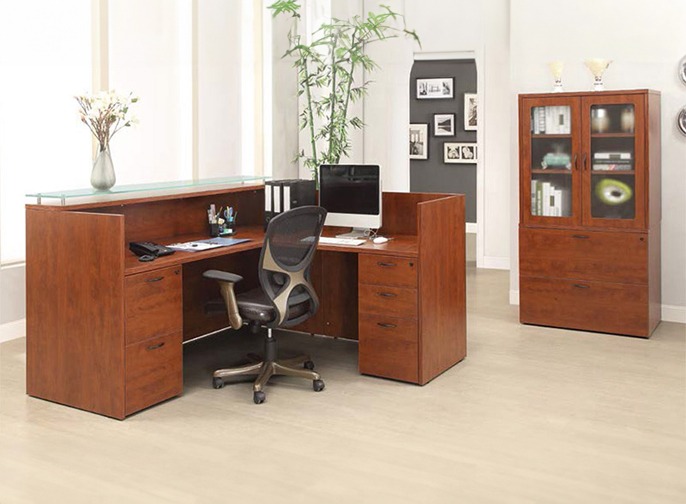
How to Choose a Reception Desk: Sizes, Shapes, Materials and ADA Requirements

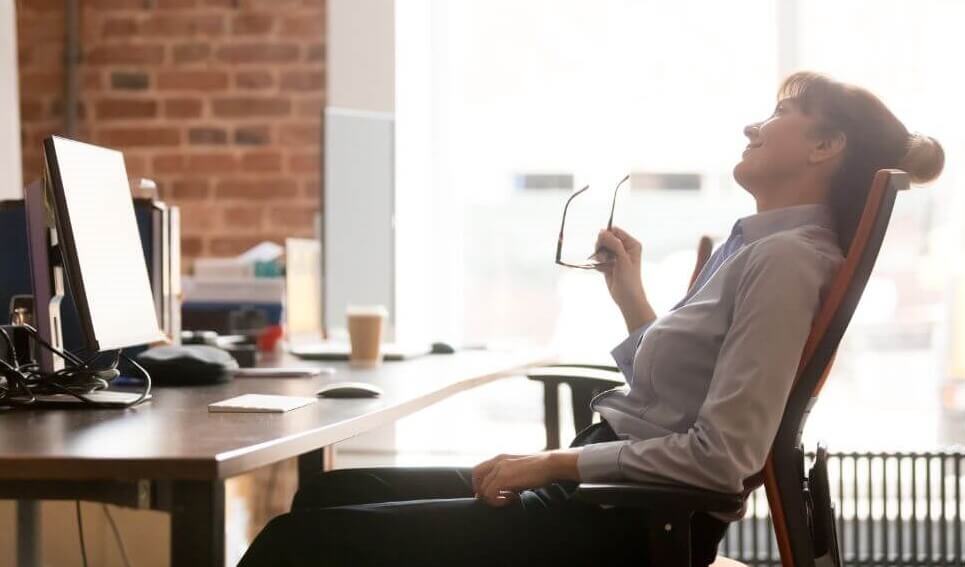
If you’ve ever felt that familiar shooting pain travel from your lower back down through your leg during a long workday, you already know sciatica doesn’t just hurt. It derails your focus, your productivity, and your patience. At BKM Office Furniture, we’ve spent decades helping San Diego businesses furnish their spaces, and few questions come up more often than this one: “What’s the best chair for someone with sciatica?”
The honest answer isn’t a single model. It’s understanding what your body needs, and then matching that to the right chair. Here’s how we think about it.
The sciatic nerve is the longest nerve in your body, running from your lumbar spine through your hips, buttocks, and all the way down each leg. When it gets compressed, often by a herniated disc, tight piriformis muscle, or prolonged poor posture, the result is that unmistakable combination of burning, tingling, or numbness.
Sitting is particularly problematic because it concentrates pressure directly on the structures surrounding the sciatic nerve. The wrong chair doesn’t just fail to help. It actively makes things worse over the course of an 8-hour day.
Generic guides will hand you a checklist. We’d rather explain the reasoning behind each feature, because the right configuration is different for every person.
The natural lumbar curve varies significantly from person to person. A lumbar support set too high, too low, or with too much projection can increase disc pressure rather than reduce it. Look for chairs where both the height and depth of lumbar support are independently adjustable. If you can’t position it precisely at the small of your back, it’s not doing its job.
Most people focus on armrests and lumbar, but seat depth may be the single most impactful dimension for sciatica. A seat that’s too deep forces you to either slouch (rotating your pelvis backward and flattening the lumbar curve) or perch at the edge (eliminating thigh support). You want 2 to 3 fingers of clearance between the front edge of the seat and the back of your knees. Many commercial-grade chairs offer a sliding seat pan for exactly this reason.
A thicker cushion isn’t necessarily better. Memory foam that bottoms out after two hours, or overly firm foam that creates pressure points, can both exacerbate sciatic pain. Mid-density foam with a waterfall front edge, one that curves downward rather than pressing into the back of your thighs, is generally what ergonomic specialists recommend.
Ergonomic alignment starts with getting your feet flat on the floor and your thighs roughly parallel to it. If the chair’s height range doesn’t accommodate your body and your desk height together, everything else becomes a workaround.
This one matters more than it sounds. Heat and moisture buildup cause people to shift and fidget, subtly breaking posture and increasing nerve pressure over time. Mesh backs and breathable upholstery help you stay settled in the right position.
We stock hundreds of seating options at our San Diego showroom. These three come up consistently in conversations with customers managing sciatic pain:
5996 BA Executive High Back Chair with Headrest: The high backrest matters here more than the headrest: it encourages the full length of the spine to be supported, reducing the tendency to round forward as fatigue sets in. For customers who find that upper back tension compounds their lower back symptoms, the integrated headrest also allows periodic neck decompression throughout the day, something you won’t find on most mid-backs.
58106 Budget Executive LeatherPlus Chair: We’re upfront about this being a value-tier chair, but it punches above its price point for sciatica specifically because of its seat design. The LeatherPlus surface is firm enough to maintain good posture without the bottoming-out problem common in heavily padded budget chairs. If you’re outfitting a team and need a reliable ergonomic baseline without a premium price tag, this is our go-to recommendation.
510101 LeatherPlus Executive Chair: The built-in lumbar support on this model is well-positioned for most adults and paired with a high backrest that promotes upright posture. The LeatherPlus upholstery is easy to wipe down, practical for anyone using a lumbar cushion or heat/cold therapy pad as an adjunct treatment, since those tend to leave marks on fabric chairs.
No chair eliminates sciatica. If you’re managing an active flare-up, the chair is one piece of a larger picture that likely includes your physical therapist, your workstation height, how often you’re standing or walking, and whether you’re incorporating movement breaks throughout the day.
What a good chair can do is stop making things worse, and in a condition where cumulative daily irritation is a major driver of symptom severity, that’s genuinely significant.
If you’re in the San Diego area, we’d encourage you to come sit in a few options at our showroom rather than ordering blind. Sciatica is personal, and what works for a 5’4″ person with a posterior pelvic tilt is different from what works for a 6’2″ person with tight hip flexors. Our team is happy to walk through the options with you.
Visit BKM Office Furniture in San Diego
Questions about ergonomic seating or outfitting a full office? Contact BKM directly. We’ve been helping San Diego businesses get this right since 1983.